

What is a wedding order of service?
A wedding order of service is a printed programme that outlines the sequence of your ceremony. It tells guests what will happen, when to stand or sit, and which hymns, prayers, readings, or songs are included. It also names the couple, the date, and the venue, and often includes the words to any responses or verses so everyone can join in.
An order of service is not a legal requirement, but it is a thoughtful and practical addition to any wedding. It helps guests feel included, especially those who are unfamiliar with your faith or ceremony style. It also makes a lovely keepsake for you and your guests.
Do you need an order of service for a wedding?
No, you do not need an order of service for a wedding. It is entirely optional. Many couples choose to have one because it keeps the ceremony organised and helps guests follow along. For ceremonies with many parts, such as a Catholic Mass or a Hindu wedding, an order of service can be very helpful.
For a short civil ceremony, you might decide an order of service is unnecessary. But even a simple one can add a personal touch. If you are having a humanist ceremony, your celebrant will often provide a script, and you can turn that into an order of service if you wish.
From us
Website packages · Wedding print Wedding websiteE-Invite£149 one-offOne beautiful page with the details, a map and a family RSVP, sent by link, QR code or WhatsApp.See E-Invite →
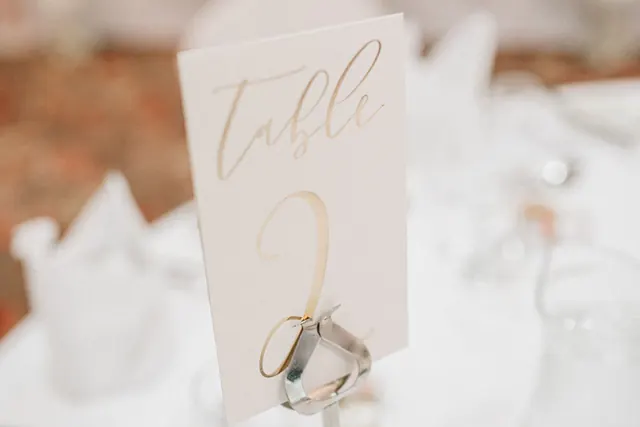 Wedding printTable numbers and place cardsfrom £14.52Folded tent cards for table numbers, table names, place cards and drink menus.Design it online →
 Wedding printOrder of service bookletsfrom £78.64Stapled booklets for the order of service, hymns, readings and the people in your wedding party.Design it online →
 Wedding printFolded menus and programmesfrom £48.78Creased and folded cards for menus, a simple order of service or the plan for the day.Design it online →
 What should you include in a wedding order of service?
A typical order of service includes the couple's names, the date, and the venue. Then it lists each part of the ceremony in order, such as the processional, welcome, readings, vows, ring exchange, and the pronouncement. If there are hymns or songs, include the title and the words. For prayers or responses, print them in full so guests can read along.
You can also add a thank you to your guests, a note about confetti or photography, and the names of your bridal party and readers. For a religious ceremony, you might include a short explanation of any rituals, such as the lighting of a candle or the sharing of peace. For a humanist wedding, you can include the story of how you met or a favourite quote. Keep the design clean and the text easy to read.
What is the order of service for a Church of England wedding?
A Church of England wedding usually follows the Book of Common Prayer or Common Worship. The order often includes the processional, the welcome and introduction, hymns, readings, the marriage ceremony with vows and rings, prayers, and the blessing. The registrar or vicar will guide you, and you can choose which hymns and readings to include.
Your vicar will provide the exact wording for the vows and any responses. You can print these in your order of service so guests can follow. Remember that Church of England weddings require banns or a licence, and you will need two witnesses. The order of service can be as traditional or as modern as you like, within the church's guidelines.
What is the order of service for a Catholic wedding in the UK?
A Catholic wedding is usually a Nuptial Mass, which has a set structure. The order includes the entrance procession, the greeting, the Liturgy of the Word with readings and a psalm, the homily, the Rite of Marriage with vows and rings, the Prayer of the Faithful, the Liturgy of the Eucharist, and the final blessing. There may be hymns at the entrance, during the offertory, at communion, and at the end.
Because the Mass is long and has many parts, an order of service is very helpful. You can include the words to the responses and hymns so guests can participate. Your priest will give you the exact text. If you are not having a full Mass, the order will be shorter, but it will still include the Liturgy of the Word and the Rite of Marriage.
What is the order of service for a humanist wedding?
A humanist wedding is completely personalised and written by your celebrant. The order often includes the processional, a welcome and introduction, readings and poems, your love story, the vows and ring exchange, and the pronouncement. There may be symbolic acts, such as handfasting or a sand ceremony, and music or songs that are meaningful to you.
Your celebrant will help you craft the order of service. You can include the full text of your vows and readings so guests can follow. Humanist weddings are legally binding in Scotland and Northern Ireland, but not in England and Wales. If you are in England or Wales, you may need a separate civil ceremony to make the marriage legal. Check GOV.UK for the current position.
What is the order of service for a Hindu wedding?
A Hindu wedding is rich with rituals and can last several hours. The order varies by region and family tradition, but often includes the Ganesh puja, the arrival of the groom, the kanyadaan, the tying of the mangalsutra, the saptapadi (seven steps around the sacred fire), and the blessing of the couple. There may be music, chanting, and the exchange of garlands.
Because there are many steps, an order of service is very useful for guests who are not familiar with the rituals. You can list each ceremony in order and add a short explanation of its meaning. You might also include the words to any mantras or songs. Your priest or family elders can help you write it. Remember that a Hindu ceremony on its own is not legally binding in England and Wales unless it takes place in a registered building with an authorised person. Many couples have a civil ceremony as well.
How do you write and print a wedding order of service?
Start by listing every part of your ceremony in the exact order it will happen. Ask your officiant, vicar, priest, or celebrant for the correct wording of any vows, prayers, or responses. Then write the text in a clear, simple layout. Use a readable font and leave plenty of white space. You can add a cover with your names and date, and a back page with a thank you.
For printing, you have several options. You can print them at home on good quality paper, or use a professional print service. Many online printers offer booklet printing, and you can also use a local print shop. If you are using a wedding website or e-invites, you can include a digital version of the order of service for guests to view on their phones. For the printed copies, a good rule is to order one per guest, plus a few extra for the couple, the officiant, and any photographers. You can also print them on card or paper that matches your stationery theme.
Checklist
- Decide if you want an order of service for your ceremony.
- Ask your officiant for the exact order and wording of the ceremony.
- List every part of the ceremony in order, from processional to recessional.
- Include the words to hymns, prayers, responses, and readings.
- Add a cover with your names, date, and venue.
- Proofread the text carefully and ask someone else to check it.
- Choose a printing method: home, online, or local print shop.
- Order one per guest plus a few extras.
- Consider a digital version for guests who prefer to use their phones.
- Keep a few spare copies in case of spills or last-minute guests.
Questions on this topic
- What goes in order of service for a wedding?
- What is the typical order of service for a wedding reception?
- Who speaks in what order at a wedding?
- Can I create my own order of service for my wedding?
- Who walks down the aisle in a traditional wedding?
- Who typically walks down the aisle first during a wedding ceremony?
- Who says vows first, husband or wife?
- What does an order of service look like for a wedding?



 Wedding invitations
 Save the date cards
 Table plan boards
 Welcome signs
 Thank-you cards