

What is an order of service for a civil ceremony?
An order of service is a printed or digital programme that tells your guests what will happen during your wedding ceremony. For a civil ceremony in England and Wales, it is a helpful way to guide guests through the legal parts and your personal choices. It also doubles as a keepsake for the day.
A civil ceremony is a non-religious legal ceremony. It can take place at a register office, an approved venue, or a religious building registered for marriages. The registrar conducts the ceremony and ensures the legal requirements are met. Your order of service should reflect the actual flow of the ceremony, so guests know what to expect and when to stand, sit, or take part.
What can and cannot be included in a civil ceremony order of service
In England and Wales, civil ceremonies cannot include religious content. That means no hymns, prayers, or religious readings. You cannot have religious symbols or references in the ceremony itself. The registrar has the final say on what is acceptable.
You can include poems, songs, and non-religious readings, as long as the registrar agrees. Many couples choose readings about love, commitment, or nature. You can also include personal vows, ring exchanges, and symbolic acts like a sand ceremony or a handfasting, if the registrar allows. Always check with your registrar before you print your order of service, so you know exactly what is allowed.
From us
Website packages · Wedding print Wedding websiteE-Invite£49 one-offOne beautiful page with the details, a map and a family RSVP, sent by link, QR code or WhatsApp.See E-Invite →
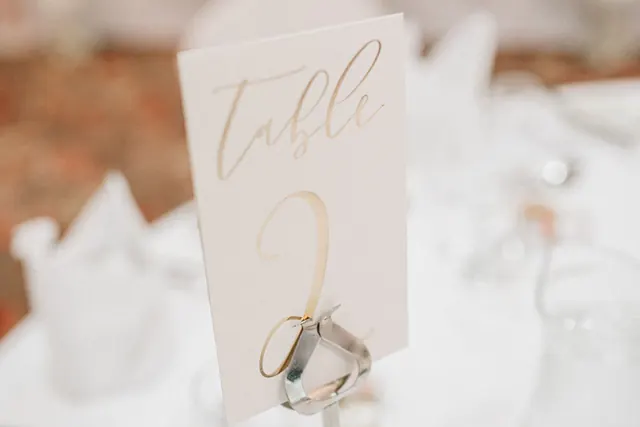 Wedding printTable numbers and place cardsfrom £14.52Folded tent cards for table numbers, table names, place cards and drink menus.Design it online →
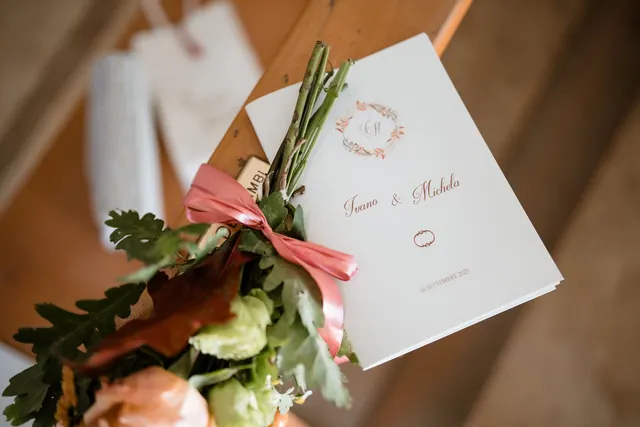 Wedding printOrder of service bookletsfrom £78.64Stapled booklets for the order of service, hymns, readings and the people in your wedding party.Design it online →
 Wedding printFolded menus and programmesfrom £48.78Creased and folded cards for menus, a simple order of service or the plan for the day.Design it online →
Typical structure for a civil ceremony order of service
A typical civil ceremony order of service follows a simple structure. Here is a common outline:
- Welcome and introduction by the registrar
- Opening words or a reading chosen by you
- Legal declaration: the registrar asks if you know of any legal reason you cannot marry
- Consent: you both say "I do" or similar words to confirm you are free to marry
- Exchange of vows (your own words or the registrar's standard vows)
- Exchange of rings (optional)
- Symbolic act (optional, if allowed)
- Signing of the marriage schedule (this is the legal document you sign on the day)
- Pronouncement: the registrar declares you married
- Closing words and exit
Your registrar will give you the exact order for your ceremony. Use that as your guide. You can add or remove non-religious elements, but the legal parts must stay in place.
How to write and design your order of service
Start by listing the parts of your ceremony in the order they will happen. Write each part in clear, simple language. Use headings or bold text for each section, and include the names of anyone who is reading or taking part. If you have music, list the song titles and the artist or composer.
Design your order of service to match your wedding theme. Choose a colour scheme and font that fit your stationery. Keep the text large enough to read easily. You can include a cover with your names and the date, and a back page with a thank-you note to your guests. If you have a wedding website, you can add the order of service there too, but many couples still like a printed version for guests to hold.
Printing your order of service: practical tips
You can print your order of service at home or use a professional print service. If you print at home, use good quality card or paper. Check your printer settings so the text is centred and the pages are in the right order. For a professional finish, consider a print shop that offers order of service booklets. They can help with folding, binding, and finishing options like matt or gloss lamination.
Think about how many copies you need. You will need one for each guest, plus a few spare for the registrar, the witnesses, and yourself. If you have a lot of guests, you might want to print a simple one-page order of service instead of a booklet. You can also make a digital version for guests who cannot attend in person, but the printed copy is still the main one for the ceremony.
Order of service for religious ceremonies: a quick note
This guide focuses on civil ceremonies, but you may be planning a religious wedding. In that case, the order of service will follow the traditions of your faith. For example, a Church of England wedding usually includes hymns, prayers, and Bible readings. A Catholic wedding has a full Mass or a ceremony without Mass. A humanist wedding in England and Wales is not legally binding on its own, so you would need a civil ceremony as well. In Scotland and Northern Ireland, humanist weddings can be legal.
If you are planning a religious ceremony, ask your officiant for the order of service. They will give you the exact structure and tell you what you can include. For a Hindu, Jewish, Greek Orthodox, or Lutheran wedding, the traditions vary widely, so always follow the guidance of your religious leader.
Making your order of service personal and inclusive
Your order of service is a chance to reflect your personality and your relationship. You can include a favourite poem, a short story, or a meaningful quote. You can also add a note about your wedding website or gift list, but keep it simple. If you have a blended family, you can include children in the ceremony and list their roles in the order of service.
Be mindful of your guests. Some may not be familiar with civil ceremonies, so a clear order of service helps everyone feel included. You can also add a line at the bottom like "Please turn off your phones" or "Photographs are welcome during the ceremony, but please avoid using flash." This keeps your guests informed and makes the ceremony run smoothly.
Checklist
- Check with your registrar which elements are allowed in your civil ceremony
- List the ceremony parts in the exact order they will happen
- Choose non-religious readings, poems, or songs that the registrar approves
- Include the names of anyone taking part, such as readers or witnesses
- Decide on a design that matches your wedding stationery
- Print enough copies for all guests plus a few spares
- Proofread your order of service for spelling and layout
- Consider a digital version for guests who cannot attend
- Add practical notes for guests, like turning off phones
- Keep a copy for yourself as a keepsake
Questions on this topic
What goes in order of service for a wedding?
An order of service is a printed booklet that guides guests through the ceremony, listing the music, readings, vows and who takes part. It usually names the couple, the date and venue, and includes the words to any hymns or responses so everyone can join in. Read the full answer
What is the typical order of service for a wedding reception?
A wedding reception order of service is a simple card or sign showing the running order of the day, from drinks and photos through to the meal, speeches, cake and dancing. It is not a legal document, just a friendly guide so guests know what happens when. Read the full answer
Who speaks in what order at a wedding?
There is no fixed legal order of speakers at a UK wedding. The order depends on your venue, ceremony type and personal choice. The registrar or officiant usually leads the legal part first, then readings, vows and rings, followed by any speeches you choose to include. Read the full answer
Can I create my own order of service for my wedding?
Yes, you can create your own order of service for your wedding. It is a printed or digital programme that lists the ceremony order. You can design it yourself or use a template, and you can include hymns, readings, vows and names of the wedding party. Read the full answer
Who walks down the aisle in a traditional wedding?
In a traditional UK wedding, the bridal party walks down the aisle first, then the bride walks last, usually with her father or another close relative. But traditions vary widely, and many couples now choose their own order, including walking together. Read the full answer
Who typically walks down the aisle first during a wedding ceremony?
Typically, the ushers or groomsmen walk down the aisle first, followed by the bridesmaids, then the bride. But this is just a custom. You can choose any order that works for you, and many couples now walk together or have parents walk first. Read the full answer
 Wedding invitations
 Save the date cards
 Table plan boards
 Welcome signs
 Thank-you cards