

How should I decorate a wedding table?
Start with the table shape and size, then build your design from the base up. Choose your linen first: a crisp white tablecloth, a coloured runner, or bare wood with a textured table runner. Then add your centrepiece, candles, and place settings in layers. Keep the overall look balanced so guests can see each other and talk easily.
Think about the theme and the season. For a winter wedding, use pine cones, berries and warm candlelight. For a summer garden wedding, use loose flowers in low vases and fresh herbs. For a cultural or faith-based wedding, include meaningful items such as a unity candle, a family heirloom, or a symbolic cloth. Always check with your venue about what is allowed on tables, especially if they supply linen or have open-flame restrictions.
How much space should there be between wedding tables?
Leave enough room for guests to sit, stand, and move comfortably. Aim for at least 90 centimetres between the edges of tables so chairs can be pulled out and servers can pass. For round tables, allow about 120 centimetres between them. If you have a dance floor or a buffet, keep a clear path of at least 150 centimetres.
Check your venue's floor plan and fire safety rules. They will tell you the maximum number of tables and the minimum aisle widths. Measure the room yourself if you can, and use masking tape on the floor to mark table sizes before the wedding day. This helps you avoid overcrowding and makes the room feel open and welcoming.
From us
Website packages · Wedding print Wedding websiteWedding Website£499 one-offYour full wedding website with RSVP for every event, meal choices and a private link for each household.See Wedding Website →
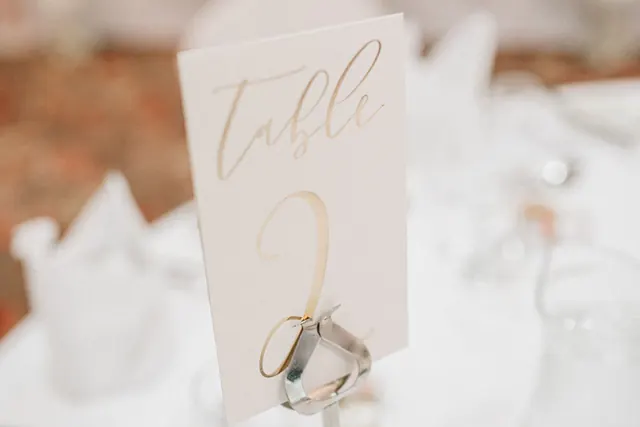 Wedding printTable numbers and place cardsfrom £14.52Folded tent cards for table numbers, table names, place cards and drink menus.Design it online →
 Wedding printPrinted wedding invitationsfrom £36.28Printed invitations and save the dates on quality card, with a QR code that opens your wedding website.Design it online →
 Wedding printThank-you cardsfrom £42.34Folded thank-you cards with your favourite photo from the day on the front.Design it online →
 How many people should sit at each wedding table?
The number depends on the table shape and size. Round tables usually seat 8 to 10 guests comfortably. Rectangular tables can seat 6 to 12, depending on length. A long banquet table can seat 20 or more if you use bench seating or continuous chairs. For a more intimate feel, seat 6 to 8 per table. For a lively, social atmosphere, seat 10 to 12.
Think about how people know each other. Seat couples and families together, but mix friend groups so conversations flow. For a 100-guest wedding, you might have ten round tables of 10, or eight tables of 12 with a few smaller ones. Always confirm your final numbers with your caterer and venue, as they need to know the exact seating capacity.
How many tables do I need for 100 wedding guests?
Work backwards from your guest list and table size. For 100 guests, ten round tables of 10 is a classic choice. If you prefer rectangular tables, you could use eight tables of 12 or 13, plus a smaller table for any overflow. Remember to include a table for the couple if you want a sweetheart table, or seat them at the top table with their parents or bridal party.
Count your tables carefully and add one spare table for gifts, the cake, or a guest book if space allows. Tell your venue and caterer the exact number of tables you need, and confirm they have enough chairs, linen, and place settings. It is better to have one empty table than to turn guests away.
How big should wedding table numbers be?
Table numbers should be easy to read from across the room, so guests can find their table without squinting. A good size is 15 to 20 centimetres tall for the number or name. Use a clear font and high contrast, such as black on white or gold on dark. Place the number in a stand, on a small easel, or propped against a vase.
If you use table names instead of numbers, make them short and visible, like "Rose" or "The Lake". Print them on card, wood, acrylic, or even a framed photo. For a large wedding, consider a seating chart at the entrance so guests can look up their table number before they walk in. That way, the table number only needs to be seen from a few metres away.
How tall should a wedding centrepiece be?
Keep centrepieces low enough for guests to see each other across the table. A good rule is to keep them below 30 centimetres tall, or above 60 centimetres if you want a tall arrangement. Low centrepieces are best for conversation and for long tables. Tall centrepieces, such as candelabras or hanging florals, work well for round tables but must not block sightlines.
If you choose tall centrepieces, make sure they are stable and not too wide. Guests should be able to reach their plates and glasses without knocking anything over. For a mixed look, use a few tall pieces on some tables and low pieces on others. Always test your centrepiece height with a chair pulled out to make sure it does not interfere.
How do I make my own wedding centrepieces and candles?
Making your own centrepieces can save money and add a personal touch. Start with simple materials: glass vases, jars, or tin cans wrapped in ribbon. Fill them with seasonal flowers from a local market, or use greenery, branches, and dried flowers. For a non-floral look, use fruit, pine cones, shells, or stacks of books. Arrange them in odd numbers, like three or five, for a natural feel.
For candles, you can make your own using wax, wicks, and heatproof containers. Melt the wax in a double boiler, add a wick, and pour into jars or teacups. Use soy or beeswax for a cleaner burn. Always place candles on a heatproof mat or saucer, and keep them away from fabric and flowers. Check your venue's rules on open flames; many allow candles in enclosed glass holders. If not, use LED candles that flicker realistically.
How should I set a wedding table?
Set the table in a logical order: charger or placemat, dinner plate, then cutlery from the outside in. Forks go on the left, knives and spoons on the right, with the blade facing the plate. Place the dessert fork and spoon above the plate. Put the glass on the right, above the knife, and the bread plate on the left if you use one.
Add a napkin on the plate or to the left, folded simply or with a sprig of herbs. Place a small favour or a name card on each setting if you have them. For a buffet, you do not need full cutlery at each seat; instead, put a rolled napkin with cutlery at each place. Keep the setting uncluttered so guests have room to eat and talk. Check with your caterer if they provide the tableware, as many venues include basic white china and glassware.
Checklist
- Measure the room and plan table spacing with your venue
- Decide on table shapes and sizes based on your guest count
- Choose linen, runners, and place settings that match your theme
- Keep centrepieces low (under 30cm) or tall (over 60cm) for clear sightlines
- Make or buy table numbers that are readable from across the room
- Set cutlery, glassware, and napkins in the correct order
- Test your candles and check venue rules on open flames
- Create a seating plan that mixes friends and families
- Count tables and confirm with your caterer and venue
- Prepare a spare table for gifts, cake, or guest book
Questions on this topic
- How to decorate the head table at a wedding reception?
- How many tables for 100 guests wedding reception?
- How to decorate a wedding table cheaply?
- How far apart should tables be at a wedding reception?
- Is it cheaper to make your own wedding centerpieces?
- How to plan decorations for a wedding?
- What is the 3-5-7 rule in decorating?
- What are some creative ways to decorate wedding tables?



 Save the date cards
 Order of service booklets
 Table plan boards
 Welcome signs