

How to Choose Your Wedding Colours
Start with your venue. Look at the fixed elements you cannot change: the carpet, the walls, the brickwork, the garden foliage, or the sea view. Pull two or three colours from those surroundings and let them lead your palette. If your venue is a bright modern loft, you might choose clean whites and one strong accent. If it is a stone barn, earthy greens and warm creams will sit naturally.
Next, think about the mood you want. Do you want calm and romantic, bold and lively, or traditional and formal? Write down three words that describe the feeling, such as "soft", "cosy" or "festive". Then choose colours that match those words. A soft mood might use blush pink and dove grey. A cosy mood might use rust and forest green. A festive mood might use jewel tones like emerald and sapphire.
Finally, gather inspiration from your own life. Look at your favourite clothes, your home décor, a piece of art you love, or a photo from a walk. These personal touches will make the scheme feel yours. You do not need to follow trends, but if you want a starting point, popular themes include rustic, botanical, vintage, coastal, minimalist, and modern glam. Each theme suggests its own colour family, but you can adapt any theme to suit your taste.
How Many Wedding Colours Should You Have
A good rule is to use three to five colours in total. Start with one main colour, one secondary colour, and one accent. The main colour appears in the biggest areas, such as table linens and bridesmaids' dresses. The secondary colour supports it in stationery and napkins. The accent is used sparingly, in flowers, candles, or ribbon.
You can add a neutral as a fourth colour. White, cream, grey, beige, or tan help the other colours stand out and give your eye a rest. If you want a fifth colour, choose a lighter or darker shade of one you already have. That keeps the scheme cohesive without feeling busy.
Avoid using too many colours. More than five can look chaotic and make it harder to match everything from invitations to table décor. If you love a wide range, choose one or two main colours and let the rest appear only in small details like confetti or favours.
From us
Website packages · Wedding print Wedding websiteWedding Website£499 one-offYour full wedding website with RSVP for every event, meal choices and a private link for each household.See Wedding Website →
 Wedding printWedding welcome signsfrom £20.38Rigid welcome boards for the entrance or an easel, printed with your names and date.Design it online →
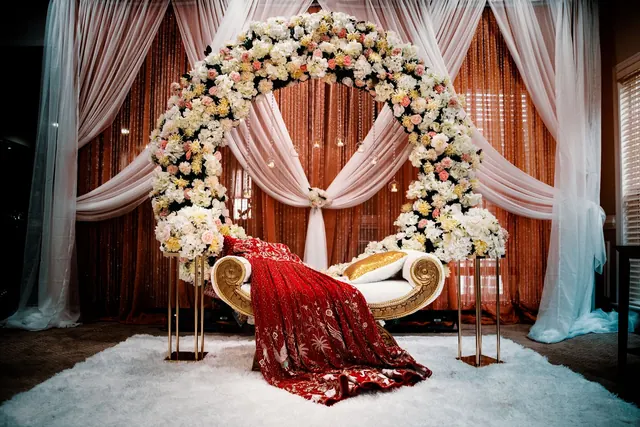 Wedding printWedding backdropsfrom £57.26Large printed backdrops behind the top table, the cake or the ceremony.Design it online →
 Wedding printPrinted wedding invitationsfrom £36.28Printed invitations and save the dates on quality card, with a QR code that opens your wedding website.Design it online →
 What Wedding Theme Should You Choose
Your theme is the overall style that ties your colours, décor, and venue together. It does not have to be complicated. A theme can be as simple as "modern garden party" or "cosy winter lodge". Choose a theme that fits your venue and your personality, not one that feels forced.
Popular themes in the UK include:
- Rustic barn: natural wood, hessian, wildflowers, and earthy tones.
- Botanical: lush greenery, ferns, and muted greens with white or cream.
- Vintage: lace, pastel colours, and antique glassware.
- Coastal: blues, sandy neutrals, driftwood, and seashell accents.
- Minimalist: clean lines, white, grey, and one bold accent.
- Modern glam: metallics, black, white, and crystal or mirrored details.
Your theme should guide your colours, but it should not limit them. A rustic barn can work with deep burgundy in autumn or pale yellow in spring. The key is to keep the theme consistent across your invitations, ceremony arch, table settings, and signage. That is what makes the whole day feel put together.
How to Match Your Colours to the Season
Seasonal colours help your wedding feel at home in its time of year. For spring, think fresh and light: pastel pink, sage green, butter yellow, and soft lilac. These colours suit April and May weddings and pair well with blossom and daffodils.
For summer, go brighter or softer depending on your venue. Good summer colour schemes include coral and aqua, lemon and white, or lavender and mint. August weddings can handle vivid shades like fuchsia and turquoise, or you can keep it airy with pale blue and cream.
For autumn, choose warm and rich colours: burnt orange, rust, mustard, deep red, and forest green. These colours work beautifully with wooden tables, dried flowers, and candlelight. If you are having an autumn wedding, you can also ask guests to wear colours that complement the scheme, such as burgundy, olive, or navy, though you should never demand a dress code.
For winter, use cool and cosy colours: icy blue, silver, white, and deep green, or go for the warmth of burgundy and gold. Winter schemes often include lots of candlelight and evergreen foliage, which makes the colours glow.
How to Carry Your Colours from Invitations to Table Décor
Once you have your palette, use it everywhere in a consistent way. Your invitations are the first thing guests see, so they set the tone. Use your main and accent colours on the invitation, the envelope liner, and the RSVP card. If you are using wedding websites or e-invites, choose the same colours for the design.
On the day, repeat the colours in these places:
- Ceremony arch or backdrop
- Bridesmaids' dresses or groomsmen's ties
- Buttonholes and bouquets
- Table linens, napkins, and chair covers
- Table numbers and place cards
- Cake and favours
- Signage, such as a welcome board or order of service
You do not need to match everything exactly. Different shades of the same colour look natural and layered. For example, if your main colour is sage green, use pale sage for napkins and deeper sage for the table runner. That creates depth without clashing.
If you are unsure, use a colour wheel. Colours next to each other, like blue and green, are harmonious. Colours opposite each other, like blue and orange, are bold and energetic. Both work, but if you want a safe and elegant look, stick to adjacent colours or shades of one colour.
Should the Bridal Shower Match the Wedding Theme
It is a nice touch if your bridal shower, hen do, or engagement party uses a few of your wedding colours, but it does not have to match exactly. The shower is often hosted by someone else, and they should feel free to choose their own theme. If they want to match, suggest they use your main colour as the tablecloth or in the balloons, and keep the rest simple.
For the hen do, matching is even less important. The hen do is about having fun, and the colours can be whatever the group enjoys. If you are having a themed hen do, like a 90s party or a beach day, that theme can be completely separate from your wedding.
The important thing is that your wedding day itself feels cohesive. Pre-wedding events can be more relaxed. If you do want to match, you can send your host a small colour swatch or a photo of your invitations to guide them.
What Are the Wedding Anniversary Themes
Anniversary themes are different from wedding colour themes. They are traditional gifts or colours associated with each year of marriage. For example, the first anniversary is paper, the fifth is wood, the tenth is tin, the twenty-fifth is silver, and the fiftieth is gold. These are useful if you are planning an anniversary party or a gift for the couple.
If you are a guest looking for an anniversary gift, you can use the traditional theme as a guide. But you do not have to follow it strictly. A modern alternative is to give something that matches the couple's interests or a memory from their wedding day.
For your own wedding colours, you do not need to think about anniversary themes. They are only relevant after you are married. Focus on the colours that make you happy now, and you can always revisit them for future celebrations.
Checklist
- Look at your venue and note the fixed colours you cannot change.
- Write down three mood words you want your wedding to feel like.
- Choose one main colour, one secondary, and one accent colour.
- Add a neutral such as white, cream, grey, or tan if needed.
- Decide on a simple theme that fits your venue and personality.
- Check that your colours suit your season, from spring to winter.
- Use your palette on invitations, ceremony décor, tables, cake, and signage.
- Ask your host if they want to match the bridal shower or hen do, but do not stress about it.
- Keep your palette to three to five colours for a cohesive look.
Questions on this topic
- How many colors should a wedding have?
- Does your bridal shower have to match your wedding theme?
- What is the in-colour for weddings in 2026?
- What are some popular colors for a wedding?
- What are the 7 color schemes?
- Which 3 color combination is best?
- How to pick a wedding color scheme?
- What are the 2026 wedding color trends?



 Save the date cards
 Order of service booklets
 Table plan boards
 Thank-you cards